

Essential Equipment for a Fried Chicken Restaurant
Plan the complete line from preparation to hot service with the right capacity and workflow.
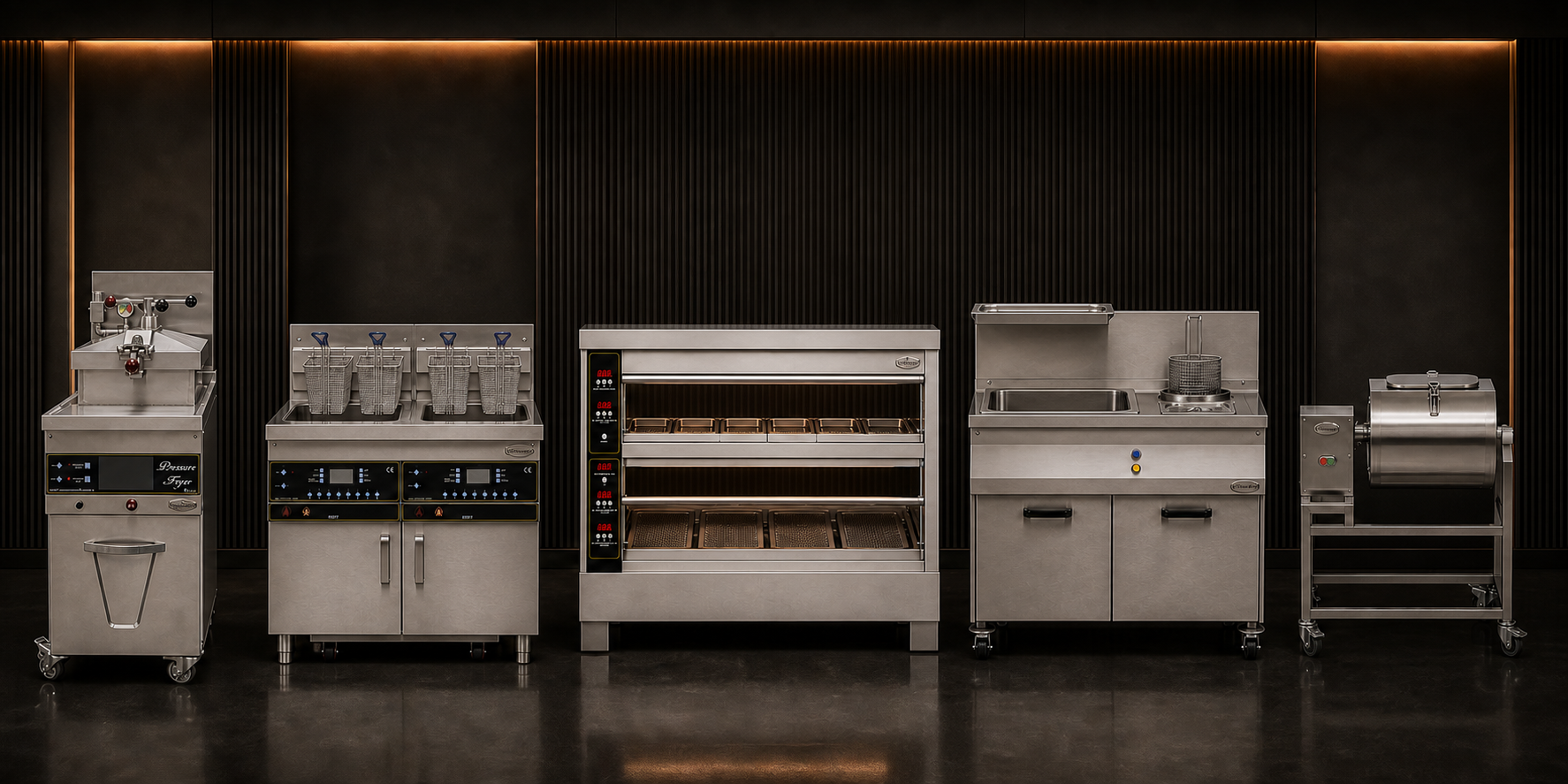
A Good Fried Chicken Kitchen Isn’t Just About the Fryer
The quality of crispy chicken becomes visible at the fryer; however, the process that determines the outcome starts much earlier. The product must be stored at the correct temperature, marinated consistently in every batch, coated with a standard preparation, and the cooked product held under proper conditions until serving time.
Therefore, when setting up a fried chicken restaurant, it is necessary to consider the entire production line rather than buying devices individually. Choosing equipment before menu, portion size, and peak order volume are clear can lead to unnecessary investment, capacity loss, or bottlenecks in the kitchen.
Choose the Right Fryer According to Your Menu’s Character
Bone-in chicken, chicken pieces, tenders, nuggets, and chicken burgers do not share the same cooking behavior. If balanced cooking within a shorter time is aimed for bone-in products, a pressure fryer is a strong option. Programmed digital fast-food fryers simplify standardized management of different recipes in operations with high menu variety.
If automatic basket lifting at the end of cooking is desired, elevator fryers ease workflow. Rack fryers offer a separate production approach in operations preparing very high quantities and multiple products simultaneously. Touch-controlled models combine advanced functions like program management, oil level monitoring, and solid fat melting within a single device.
Ottoman’s gas and electric fryers provide precise temperature control. In high-volume operations with appropriate natural gas or LPG infrastructure, gas models should be especially considered due to strong heat recovery and intense service performance. In projects with only electrical infrastructure, electric models can be planned to maintain the same recipe standard.
Marination Is the Starting Point of Flavor and Production Time
Marination is important not only for flavor but also to ensure consistent results in every batch. Standard marination units suitable for traditional workflows can be used for processes of about 15 minutes. In high-volume production, vacuum marination processes the product in about 3 minutes, increasing line speed for operators wanting to shorten preparation time.
If the restaurant plans to use pre-marinated products, a separate marination device may not be required. However, this decision should be made together with the supply method; if managing the recipe in-house later is a goal, the marination area should be planned from the start.
The Coating Standard Is Established at the Battering Station
A manual battering unit offers an economical and controlled start for low- and medium-volume operations. Sifting flour by hand requires labor; however, the process is simple and easy to manage.
As order volume increases, automatic sifting systems separate clumpy flour, collect clean and used flour in different compartments, and maintain order in the prep area. In projects where chicken, sauces, and coating ingredients must be managed together in a refrigerated area, a multifunctional refrigerated battering unit creates a more integrated station.
If Cooked Chicken Is Not Held Properly, Fryer Performance Alone Won’t Suffice
In busy service periods, products are not prepared from scratch with each order. Cooked chicken must be kept ready for service while maintaining proper temperature and humidity balance. Mechanically controlled units offer a simple and economical solution, whereas digital models help regulate temperature more precisely.
If you want the product displayed visibly to customers, chicken holding units suitable for exhibition setups can be preferred. Systems that manage water automatically reduce operational workload. In kitchens where different products must be held at separate temperatures, hot holding cabinets with independently controlled shelves offer more flexibility.
Plan Separate Capacity for Fries and Side Dishes
If only fries are offered alongside the chicken, a digital fryer dedicated to that production may suffice. Wider menus including onion rings, cheese sticks, and various snacks may call for more flexible digital fast-food fryers. If products cannot be cooked in the same oil due to taste, recipe, or allergen concerns, separate vats or separate devices should be planned.
The area where fries are portioned and salted after frying is also part of line capacity. Economical hot holders within the kitchen meet the basic need; holding units with a portioning area speed up operation in customer-visible service. Combined units managing chicken burgers and fries in separate compartments can be used in concepts where these products are held ready to serve packaged.
Kitchen Layout Should Follow the Production Sequence
Cold storage, marination, battering, cooking, and hot holding stations should be arranged in the product flow direction. Ensuring that the raw product route does not intersect with cooked product and service routes supports both work speed and food safety.
Stainless steel work tables, preparation and storage refrigerators, handwashing stations, shelves, baskets, hoods, and ventilation systems are not details to be added after the main devices. Their size and location, along with staff numbers and clean-dirty flow, should be determined at the start of the project.
Calculate Capacity Based on the Busiest Hour
Total daily sales alone do not indicate the correct equipment capacity. The main determinant is the number of portions that must be served during the busiest hour. Product weight, fryer cycle time, loading and unloading time, battering speed, and hot holding capacity should be evaluated together in the same calculation.
If the fryer works very fast but the battering station or holding unit is insufficient, the true kitchen capacity does not increase. A balanced line avoids unnecessary oversized device investments while maintaining service speed and product standard during peak hours.
Prepare This Information Before Requesting a Quote
- Chicken products and side items on the menu.
- Portion weight and target order volume during peak hours.
- Preference for liquid or solid fat.
- Available electrical power, natural gas, or LPG infrastructure.
- Kitchen layout, hood size, and usable workspace.
- Takeaway, customer-visible production, and hot holding expectations.
- Planned staff count and restaurant opening date.
Complete Fried Chicken Production Line with Ottoman
The Ottoman fried chicken line is considered as a system serving the same hourly capacity with the OTX-MRNT 25 Marination Unit, OTX-ABM Automatic Battering or OTX-ABMS Multifunctional Automatic Battering Unit, OTX-PRESSURE/OTX-PRESSUREG Pressure Fryer, and OTX-HPCHD Digital Chicken Holding Unit. For side products, the OTX-7DEFF/OTX-9DEFF Digital Fast Food Fryer and OTX-PROPATBEK French Fry Holding Unit can be added.
Even if the fryer can cook a large quantity of chicken, if the battering unit cannot keep up at the same pace, the real investment capacity is limited by the battering station. Ottoman projects calculate marination batch size, battering cycles, fryer load, and holding shelf together; devices unnecessary for the menu are not included in the package.
- Preparation: Ottoman Vacuum Marination and Automatic Battering Units.
- Cooking: Ottoman gas or electric Pressure Fryer options.
- Service: Ottoman Chicken and French Fry Holding Units.
The Ottoman difference
Why choose Ottoman Mutfak?
Ottoman combines equipment selection, capacity planning and after-sales support in one professional-kitchen project.
- Equipment options matched to your menu and peak-hour capacity
- A complete line from preparation and cooking to hot holding and service
- Technical planning focused on reliable operation, energy use and long service life